
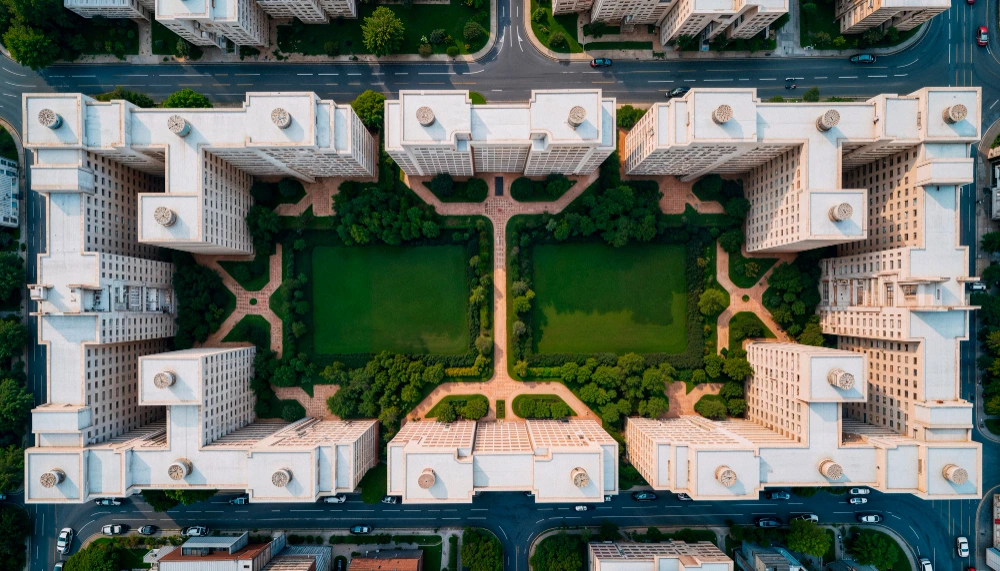
Aerial exterior rendering has become one of the most powerful visualization tools in modern architecture and real estate development. For large-scale projects from master-planned communities to mixed-use commercial complexes a Bird’s-Eye View Rendering communicates scope, site integration, and design intent in a single, compelling image. This blog explores the full value of 3D aerial rendering, the Variants of 3D Exterior Rendering available, and the Tips to Improve 3D Exterior Rendering Techniques that separate average visuals from exceptional ones.
When a development spans multiple buildings, vast landscaping, infrastructure networks, and diverse functional zones, no single eye-level camera angle can tell the whole story. A street-level render captures a facade beautifully but leaves the project’s full scale, site planning, and contextual relationship to its surroundings entirely invisible. This is the precise gap that aerial exterior rendering exists to fill.
For large developments residential communities, commercial campuses, urban mixed-use projects, resort developments, and infrastructure masterplans the elevated perspective of a 3D aerial rendering isn’t a visual luxury. It’s a strategic communication tool that shapes how investors, planning authorities, buyers, and the public understand and respond to a project before it is built.
At Arktek 3D, our 3D Architectural Exterior Rendering Services include high-quality aerial visualization that brings large-scale developments to life with photorealistic precision. This blog examines why aerial renders are essential, what types are available, and how to get the most from them.
What Is Aerial Exterior Rendering?
Aerial exterior rendering is a form of exterior 3D visualization that presents a building or development from an elevated vantage point typically simulating the perspective of a drone, helicopter, or satellite at varying heights above the project.
Also referred to as a Bird’s-Eye View Rendering or aerial view architectural rendering, this technique situates the development within its real geographic and environmental context: surrounding roads, neighbouring buildings, green spaces, bodies of water, and wider urban or natural landscape. The result is a comprehensive view that communicates spatial relationships, site layout, and the development’s relationship to its surroundings in a way that no ground-level render can achieve.
Unlike a standard Exterior Rendering that presents a single building face or courtyard, aerial renders capture the entire footprint of a project its organization, scale, density, landscaping, circulation, and environmental integration all in one image.
Why Large Developments Specifically Need Aerial Renders
The larger and more complex a project, the more essential aerial visualization becomes. Here’s why Aerial 3D Rendering is not optional for major developments:
Scale Communication Is Impossible from Ground Level
A master-planned community of 200 homes, a corporate campus with six interconnected buildings, or a mixed-use development combining retail, residential, and hospitality cannot be meaningfully communicated through a single street-level perspective. Aerial Insights gained from an elevated render allow stakeholders to grasp the true scope and spatial organization of a project at a glance.
Site Planning Requires a Macro View
Large developments involve intricate site planning decisions: pedestrian pathways, vehicular access and parking, landscape zones, building orientation for solar gain, stormwater management, and phasing plans. A Bird’s-Eye View Rendering makes these planning elements visible and verifiable, supporting both design review and planning authority presentations.
Investor and Stakeholder Confidence
For developers seeking funding or partnership, the ability to present a photorealistic aerial view of an entire development complete with accurate landscaping, accurate building massing, and accurate site context transforms an abstract investment proposition into a credible, visually compelling reality. High-quality Aerial 3D Rendering communicates professional rigour and attention to detail that immediately builds confidence.
Planning and Regulatory Approvals
Urban planning committees, zoning boards, and local authorities reviewing large developments benefit enormously from aerial visualization. When a community or council needs to assess a project’s traffic impact, shadow casting on neighbouring properties, or green space provision, an accurate aerial view architectural rendering provides the contextual clarity that plans and drawings alone cannot.
Aerial Insights: What These Renders Actually Reveal
One of the most underappreciated values of Aerial Insights from above-eye-level renders is the information density they carry. A single well-produced aerial render simultaneously communicates:
- Building massing and proportion how individual structures relate in height and footprint to one another and to neighbouring context
- Landscape integration the green spaces, planting, water features, and outdoor amenity zones that define the quality of life within a development
- Circulation and access the flow of pedestrians, cyclists, and vehicles through the site, including entry points, pathways, and parking provision
- Phasing legibility for multi-stage developments, aerial renders can show completed phases alongside planned future phases, communicating the long-term vision to buyers and investors
- Environmental harmony how the development sits within its natural surroundings, including terrain, tree canopy, and distant landscape features
This density of information in a single visual is why 3D Exterior Rendering for Architects & Designers at the aerial scale has become a standard deliverable for any serious large-scale project presentation.
Variants of 3D Exterior Rendering for Large Developments
Understanding the Variants of 3D Exterior Rendering available at the aerial and exterior scale helps design teams select the right visual approach for each project phase and audience.
Photorealistic Aerial Renders :- are fully detailed, high-resolution images that simulate real photography from an elevated position. Every surface material, tree species, shadow angle, and atmospheric condition is rendered with accuracy. These are the premium deliverable for marketing campaigns, investor presentations, and planning submissions.
Conceptual Aerial Renders :- prioritise design clarity over photorealism using simplified massing and schematic landscaping to communicate layout and spatial organization during early design phases. Ideal for internal design reviews and concept approvals before final materials are selected.
Twilight and Night Aerial Renders :- capture the development after dark, with interior lighting glowing from windows and outdoor lighting illuminating pathways, plazas, and landscape features. These renders communicate the atmosphere and energy of a development at a different time of day, and are particularly effective for marketing hospitality, mixed-use, and premium residential projects.
Seasonal Aerial Renders :- show the development in different seasons a green summer canopy, an autumn palette, or a winter snowscape demonstrating the project’s visual appeal and livability across the year. Especially valuable for resort and landscape-heavy developments.
Phasing Renders :- show the development at different stages of completion, helping buyers and investors understand what they’re purchasing or funding within the context of the long-term masterplan.
Practices for Realistic Outdoor Visualizations in Aerial Renders
Practices Realistic Outdoor Visualizations at the aerial scale require a different set of technical considerations compared to ground-level exterior work. The best aerial renders achieve their photorealism through:
Atmospheric Perspective: In the real world, distance introduces a subtle blue haze between the viewer and distant objects objects further away appear slightly desaturated and softer in contrast. Applying accurate atmospheric perspective in aerial renders creates a convincing sense of depth and scale that flat renders lack entirely.
Accurate Terrain Modeling: For developments with significant topography hillside communities, waterfront projects, or rural estates the underlying land form must be modelled accurately. A flat site representation when the real terrain is undulating immediately undermines the render’s credibility with anyone familiar with the location.
Seasonal and Time-Accurate Vegetation: Trees and planting at the aerial scale must be species-appropriate, seasonally accurate, and at the correct growth stage. Representing mature trees that won’t reach full size for 10 years, or placing tropical planting in a temperate climate, damages the render’s realism and misleads stakeholders.
Accurate Shadow Casting: At the aerial scale, shadow direction reveals building orientation and time of day simultaneously. Inaccurate shadow angles particularly for planning submissions where shadow impact on neighbours is being assessed undermine the render’s technical validity.
Infrastructure Detail: Roads, footpaths, car parks, service areas, and utilities must be accurately represented. At the aerial scale, these elements are highly visible and their accuracy signals the quality and precision of the visualization work.
Key Angles for Architectural Exterior Rendering
Selecting the right Angles for Architectural Exterior Rendering at the aerial level requires understanding what each angle communicates and which stakeholder it serves:
High Altitude Overview (60°–90° from vertical): The near-vertical bird’s eye view that shows the development’s full footprint, site organization, and relationship to surrounding infrastructure. Best for masterplan communication, planning submissions, and investor overviews.
Medium Altitude Perspective (30°–60° from vertical): The most versatile aerial angle, this view combines a macro site overview with enough perspective to show building facades, landscape character, and streetscape. The standard choice for marketing imagery and project presentations.
Low Altitude Aerial (10°–30° from vertical): Close to drone photography territory, this angle shows individual buildings from slightly above eye level, communicating architectural character, material detail, and public realm quality while retaining contextual site awareness. Excellent for residential marketing and individual building feature renderings within a larger development.
Oblique Aerial Perspective: An angled view that emphasises one corner or quadrant of the development useful for highlighting a key amenity, entrance, or architectural feature within the broader site context.
Benefits Exterior Home Rendering at Aerial Scale
For residential developments specifically, the Benefits Exterior Home Rendering from an aerial perspective are significant and measurable:
Pre-Sales Conversion: High-quality aerial renders of residential communities showing home typologies within their landscape, proximity to amenities, and neighbourhood character consistently improve off-plan sales conversion rates. Buyers respond to the context, not just the house.
Community Identity: Aerial renders communicate the character and identity of a residential neighbourhood its streetscapes, green spaces, community facilities, and architectural consistency in a way that supports premium pricing and brand positioning.
Show Home Context: For large residential developments with multiple home types, an aerial render situates the show home location within the broader development, helping buyers understand their investment within the context of the finished community.
Rendering Tools for Stunning Landscape Design
The Rendering Tools for Stunning Landscape Design at the aerial scale include industry-standard platforms that Arktek 3D’s team uses to produce photorealistic exterior visualization:
3ds Max remains the most widely used 3D modeling platform for architectural visualization, offering precise geometry control and an extensive plugin ecosystem for vegetation, terrain, and environmental elements.
V-Ray is the rendering engine of choice for photorealistic output, offering advanced lighting simulation, atmospheric effects, and material accuracy that are essential for high-quality aerial renders.
Forest Pack and RailClone are the industry-standard tools for generating large-scale vegetation and repetitive site elements the thousands of trees, shrubs, and planted areas that populate an aerial render of a large development cannot be placed manually and require procedural scatter tools to produce at the necessary density and variation.
GIS Data Integration allows terrain models to be built from real geographic survey data, ensuring that the landscape beneath a large development is topographically accurate rather than approximated.
Lumion and Twinmotion offer faster real-time rendering workflows suited to conceptual and intermediate aerial renders where speed is prioritised over ultimate photorealism.
Tips to Improve 3D Exterior Rendering Techniques for Aerial Work
These Tips to Improve 3D Exterior Rendering Techniques apply specifically to aerial-scale exterior visualization:
1. Invest in Terrain Accuracy First: Before any building model is placed, ensure the underlying site topography is correct. Everything else in the render depends on this foundation.
2. Match Vegetation to Geography: Use tree and plant species that reflect the real climate zone and seasonal timing of the project’s location. Generic tropical trees in a temperate city render immediately signal inauthenticity.
3. Control the Focal Point: Even at the aerial scale, the camera should be positioned to draw the viewer’s eye to the most important element of the development the central amenity, the main entrance, or the signature building. Aerial renders without a focal hierarchy feel directionless.
4. Layer Your Atmosphere: Apply haze, aerial perspective, and environmental depth systematically. Foreground detail, mid-ground clarity, and background softening create the perceptual depth that makes a render feel genuinely photographed from altitude.
5. Light for Drama and Accuracy Together: The most compelling aerial renders use a sun angle that is both atmospherically beautiful and technically accurate for the site’s geographic location and time of day.
Conclusion
For large developments, aerial exterior rendering is not a stylistic choice it is a strategic necessity. The ability to present an entire project’s spatial organization, landscape integration, and contextual relationship in a single photorealistic image gives developers, designers, and planning authorities the Aerial Insights they need to make confident decisions and compelling presentations.
Through professional 3D Architectural Exterior Rendering Services, Arktek 3D delivers aerial renders that combine technical accuracy, photorealistic quality, and strategic visual storytelling giving every large development the aerial perspective it needs to succeed.
Read More- Why Stunning Exterior Visuals Help Secure Real Estate Approvals and Buyers