
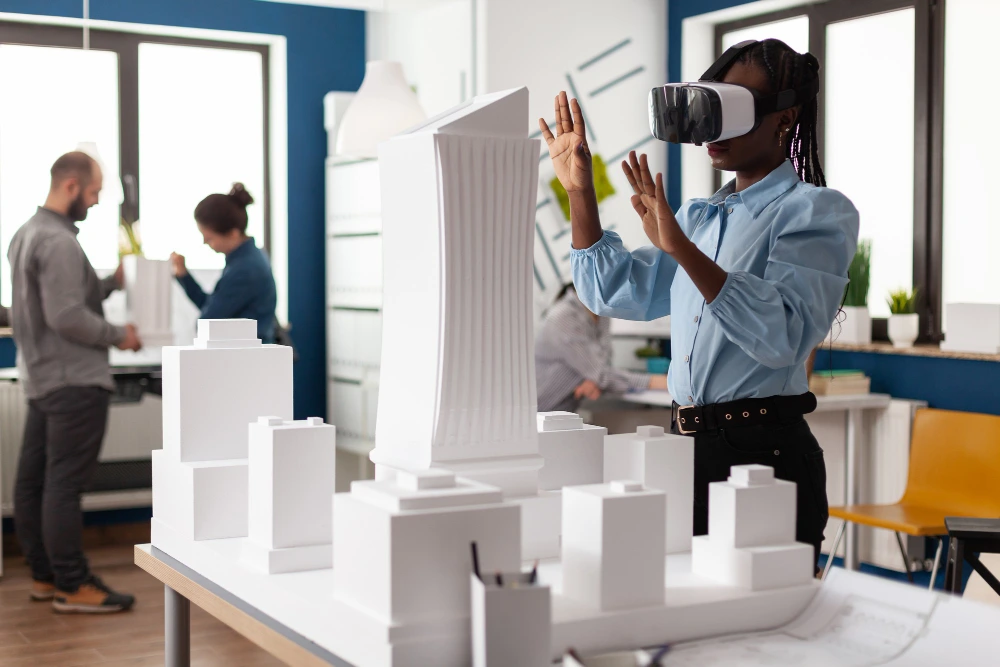
The world of Architectural Visualization is undergoing a transformative shift driven by AI, Augmented Reality, and immersive technologies. From AI-powered rendering engines to real-time AR walkthroughs, the guide of 3D Architectural Visualization in 2026 reveals a landscape where creativity, speed, and accuracy converge like never before. This blog explores the key trends, tools, and styles redefining how architects, developers, and designers communicate their vision.
The way we visualize buildings and spaces has come a long way from hand-drawn blueprints and physical scale models. Today, Architectural Visualization sits at the exciting intersection of design, technology, and storytelling. Whether you are an architect presenting a concept to a client, a developer marketing a pre-construction project, or a homeowner imagining a renovation the quality and interactivity of visual communication can make or break a decision.
In 2026, Architectural Visualization in 2026 isn’t just about producing beautiful images. It’s about creating experiences. With the rapid rise of AI-driven tools, augmented reality platforms, and photorealistic rendering capabilities, studios offering 3D Architectural Visualization Services are redefining what’s possible and what clients now expect.
This blog is your complete guide of 3D Architectural Visualization for the modern era, exploring where the industry is headed and how the technologies shaping it can benefit your next project.
The AI Revolution in Architectural Visualization
Without a doubt, the biggest disruptor in the field today is artificial intelligence. The AI Revolution in Architectural Visualization is not a distant forecast it is happening right now, across studios, design firms, and rendering pipelines worldwide.
AI in architectural rendering has dramatically compressed the time required to produce high-quality visuals. Tasks that once took days material application, lighting calibration, post-production refinement can now be completed in a fraction of the time using intelligent automation. AI-powered denoising engines, for example, can clean up low-sample renders instantly, delivering crisp results without the computational overhead of traditional methods.
AI Tools for Architectural Visualization such as Stable Diffusion-based design assistants, generative 3D modeling plugins, and AI-enhanced rendering engines are enabling designers to explore more concepts, faster. Want to see the same facade in three different material palettes? AI can generate those variations in minutes, helping teams move from concept to decision without losing momentum.
Importantly, the human element remains central. AI handles execution; the creative direction, storytelling, and design intent still demand experienced professionals. Studios that leverage AI in architectural rendering as a workflow accelerator not a replacement for skill are delivering the most compelling and accurate results.
AR in Architecture Visualization: Bringing Designs Into the Real World
If AI is transforming how visuals are produced, AR in architecture visualization is transforming how they are consumed. Augmented Reality overlays digital design information onto the real physical environment, allowing clients, contractors, and stakeholders to see a proposed building or interior within its actual context.
This technology is particularly powerful during the design review and approval phase. Instead of asking a client to mentally map a floor plan onto an empty lot, AR allows them to walk through the space spatially and intuitively using a tablet or headset. The result is faster alignment, fewer miscommunications, and decisions anchored in genuine spatial understanding.
AR is also proving valuable for site coordination. Teams can overlay structural or interior design data onto construction sites in real time, identifying clashes and verifying dimensions before costly errors occur on the ground.
As devices become more accessible and AR software becomes more sophisticated, AR in architecture visualization is rapidly moving from a cutting-edge differentiator to a standard service expectation.
A Complete Guide of 3D Architectural Visualization: Styles and Approaches
Understanding the variety of Architectural Visualization Styles available today is essential for choosing the right format for your project phase and audience.
Photorealistic Rendering remains the gold standard for marketing, investor presentations, and pre-sales. These highly detailed, true-to-life images capture every material finish, light interaction, and spatial quality with stunning accuracy. They are especially effective for Realistic Outdoor Visualizations, where landscape context, natural lighting, and environmental atmosphere bring a project’s exterior to life.
Conceptual and Stylized Visualization serves a different purpose. Used in early design stages, these looser, more abstract representations communicate mood, massing, and spatial intent without committing to final details. They invite collaboration and exploration rather than sign-off.
360° Immersive Tours are becoming a mainstream deliverable. Clients can explore a fully rendered interior or exterior environment interactively, navigating between rooms and spaces at their own pace from anywhere in the world. This format is particularly powerful for remote stakeholders and international buyers who cannot visit a site in person.
Animation and Walkthrough Videos bring a sequential, narrative quality to visualization. They guide the viewer through a designed environment with deliberate pacing, music, and curated perspective making them ideal for developer launch campaigns and high-impact pitch presentations.
Each of these Architectural Visualization Styles serves a distinct purpose. The best studios don’t choose one they match the right format to the right moment in the project lifecycle.
Storytelling in 3D Visualization: The Emotional Edge
One of the most powerful yet underappreciated aspects of advanced Architectural Visualization is its capacity for storytelling. Storytelling in 3D Visualization means going beyond technical accuracy to evoke emotion, aspiration, and a sense of lived-in life.
When a render includes a morning coffee cup on a sun-lit kitchen counter, children’s shoes by a doorway, or golden-hour light streaming through a bedroom window it’s not decorative detail. It’s intentional narrative. It invites the viewer to imagine themselves in the space, which is precisely what drives emotional buy-in and confident decision-making.
The best 3D Architectural Visualization Services understand that every render is a story. Who lives here? What does life feel like in this space? How does this building belong to its neighborhood? Answering these questions visually is what separates technically competent renderings from truly memorable ones.
Future of Architectural Visualization: Key Trends for 2026
Architectural Visualization in 2026 is being shaped by several converging trends that practitioners and clients alike should understand.
Real-Time Rendering is gaining adoption across the industry. Unlike traditional rendering pipelines where each image requires significant computation time, real-time engines update visuals instantly as the user interacts with the model. This makes live design reviews more dynamic teams can swap materials, adjust lighting, or explore alternative layouts in a single meeting rather than waiting for a new batch of renders.
Cloud Collaboration is solving the age-old problem of version chaos. With stakeholders often distributed across cities and time zones, cloud-based platforms allow design teams to share, review, and iterate on models simultaneously. The result is cleaner communication, faster approvals, and fewer costly surprises.
Sustainable and Contextual Visualization is emerging as a new expectation. Clients and communities increasingly want to see how a proposed building integrates with its natural surroundings, manages light and shade throughout the day, and responds to its environmental context. Realistic Outdoor Visualizations that include accurate sun studies, landscaping, and street-level context are becoming standard requirements, not optional extras.
3D Visualization Revolutionize Home Renovation is another major growth area. Homeowners undertaking renovations no longer need to imagine what their finished space will look like from a tile sample and a paint chip. Detailed, photorealistic 3D visualizations of kitchens, bathrooms, and living spaces allow clients to preview, adjust, and commit to renovation plans with full confidence dramatically reducing the anxiety and second-guessing that often accompanies large home improvement investments.
Why 3D Architectural Visualization Services Matter More Than Ever
In a competitive design and real estate landscape, the quality of visual communication is a direct business advantage. 3D Architectural Visualization Services are no longer a luxury add-on for premium projects they are an essential tool for winning approvals, attracting investment, and closing sales.
Consider the pre-construction scenario. A developer needs to market 200 residential units before a single foundation has been poured. Buyers are comparing multiple projects simultaneously, and attention spans are short. A compelling set of photorealistic renders paired with an immersive 360° tour transforms an abstract promise into a vivid, emotional experience. It answers the question every prospective buyer is really asking: “Can I picture my life here?”
The same logic applies to architectural competitions, planning applications, and interior design proposals. The clearer and more compelling the visual presentation, the faster and more confidently decisions are made at every level.
The Road Ahead: What’s Next for Architectural Visualization
The Future of Architectural Visualization points toward increasingly seamless integration of design, visualization, and decision-making. As AI continues to reduce production time and AR makes spatial preview more accessible, the gap between design and lived experience will continue to shrink.
We can expect visualization to become fully embedded in the design workflow not a final deliverable created once approval is near, but a living, evolving representation that updates in real time as the design develops. The most forward-thinking studios are already building toward this model, using real-time engines and AI-assisted pipelines to keep visuals current throughout every phase of a project.
The democratization of these tools also means that high-quality visualization is becoming accessible to a broader range of projects and budgets not just landmark towers and luxury developments, but also mid-scale residential projects, commercial fit-outs, and home renovations.
Conclusion
The Future of Architectural Visualization is defined by speed, intelligence, and immersion. AI is accelerating production without sacrificing quality. AR is bringing designs into spatial reality before construction begins. Immersive formats are turning passive viewers into active participants. And sophisticated Storytelling in 3D Visualization is ensuring that every image communicates not just what a space looks like but how it feels to be inside it.
For anyone involved in architecture, real estate development, interior design, or home renovation, now is the time to embrace the full potential of modern visualization. The technology is ready. The audience expects it. And the competitive advantage for those who get it right has never been greater.
At Arktek3D, we combine technical precision with creative storytelling to deliver 3D Architectural Visualization Services that move projects forward from concept to approval, and from vision to reality.