
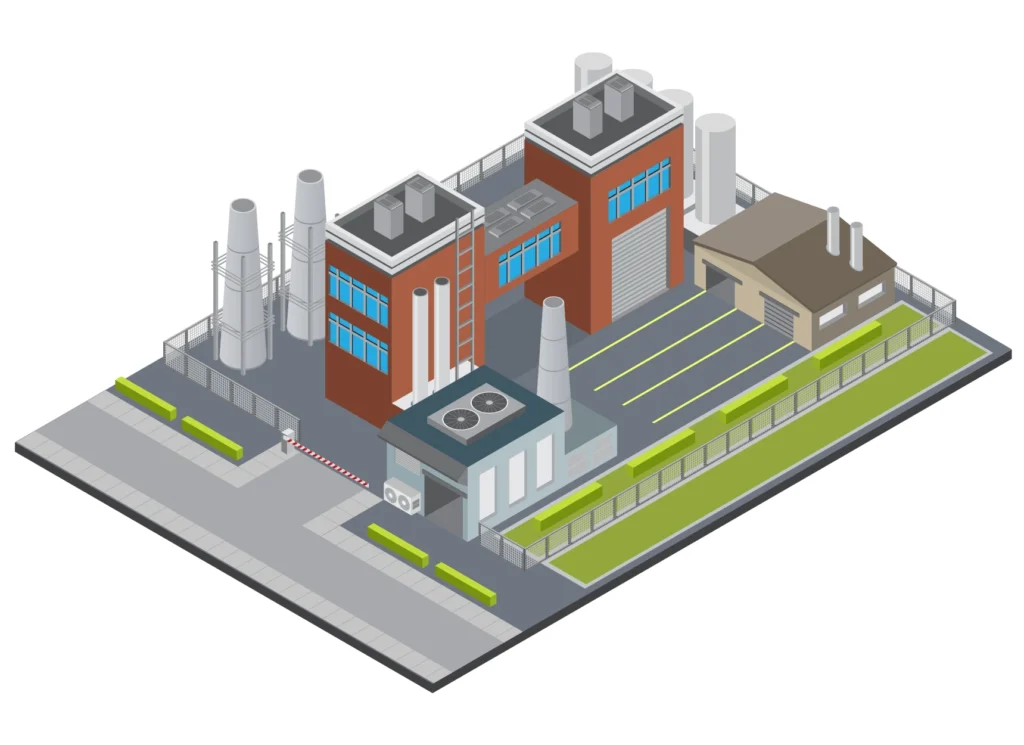
Industrial 3D rendering has become essential for visualizing complex facilities from manufacturing plants to logistics hubs before construction begins. This guide explores the key use cases and industrial 3D rendering benefits across coordination, marketing, and stakeholder communication, and shows how Arktek 3D’s industrial 3D rendering services help teams plan with clarity and confidence.
Industrial projects are defined by scale and complexity. A manufacturing plant, a logistics warehouse, a processing facility, or an energy installation involves interconnected systems, heavy machinery, structural detailing, and operational flow that simply cannot be communicated through 2D drawings alone. This is precisely the gap that industrial 3D rendering fills.
At Arktek 3D, we treat industrial facility rendering not as a decorative add-on but as a working communication tool one that translates dense technical data into visuals that engineers, contractors, investors, and decision-makers can immediately understand and act on.
What Is Industrial 3D Rendering?
Industrial 3D rendering is the process of converting technical models, architectural drawings, and engineering data into photorealistic visual representations of plants, factories, and industrial facilities. It bridges the gap between complex technical documentation and the kind of clear, intuitive imagery that non-technical stakeholders can evaluate at a glance.
Unlike residential or hospitality visualization, industrial projects come with unique demands: large-scale structures, mechanical systems, specialized equipment, and functional layouts that must be both accurate and visually coherent. The Process of 3D Rendering for industrial work follows the same fundamental stages as any other rendering project modeling, composition, materialization, and delivery but with added emphasis on structural and engineering precision.
Why Industrial Facilities Need 3D Visualization
As industrial projects have grown denser and more technically complex, the limitations of static 2D drawings have become increasingly apparent. Plans on paper struggle to convey how a facility will actually function once built, how equipment will be installed, or how multiple systems will interact within a single space.
Industrial 3D rendering services solve this by giving every stakeholder from engineers to financiers a shared, intuitive visual reference. This is especially valuable in coordination meetings, where teams need to resolve conflicts between mechanical, structural, and architectural elements before construction begins. A clear render eliminates ambiguity and accelerates the kind of cross-disciplinary decision-making that industrial projects depend on.
Use Case 1: Design Validation and Coordination
Before a single foundation is poured, industrial teams need certainty that the design works structurally, operationally, and spatially. Industrial 3D interior rendering services allow engineering and design teams to visualize how machinery, conveyor systems, storage racking, and workflow paths fit together within a facility’s footprint.
This is one of the clearest industrial 3D rendering benefits: catching spatial conflicts or workflow inefficiencies digitally, long before they become costly on-site problems. Coordination meetings become significantly more productive when every participant is looking at the same accurate visual model rather than interpreting technical drawings independently.
Use Case 2: Exterior Presentation and Site Context
The exterior of an industrial facility communicates as much about a company’s brand and values as its interior does about its operations. Industrial 3D exterior rendering services capture the building envelope, site layout, landscaping, access roads, and surrounding context giving stakeholders a complete picture of how the facility will sit within its environment.
This follows the same principles outlined in any solid Guide to 3D Exterior Rendering for Architects & Designers: accurate massing, realistic material representation, and credible environmental context. For industrial clients increasingly focused on sustainability messaging, renders can also showcase green roofs, solar installations, and other environmentally conscious design elements.
Use Case 3: Stakeholder Communication and Approvals
Industrial projects typically involve a wide range of stakeholders who do not have technical training in reading BIM models or engineering drawings investors, regulatory bodies, local communities, and executive decision-makers. Industrial facility rendering translates complex project data into visuals these audiences can immediately understand.
This capability accelerates approval processes considerably. When a planning committee or investment board can see a photorealistic representation of the finished facility, decisions move faster and with greater confidence than when working from technical documentation alone.
Use Case 4: Marketing and Investment Materials
3D Rendering for Marketing plays an increasingly important role in industrial projects, particularly for companies seeking investment, government incentives, or public support for new facilities. A polished, photorealistic render does more to communicate a project’s ambition and quality than pages of specifications ever could.
Industrial 3D renders are now standard components of investor decks, press releases, and public announcements for new manufacturing plants, energy installations, and logistics centers. They give companies a compelling visual asset that can be reused across multiple communication channels throughout a project’s lifecycle.
Use Case 5: Interior Layout and Operational Planning
3D Rendering in Interior Design principles apply directly to industrial interiors as well, albeit with a different focus. Rather than aesthetic furnishing decisions, industrial 3D interior rendering services prioritize equipment placement, safety clearances, workflow logic, and operational efficiency.
Following a proper Guide to Creating Realistic 3D Renders, the Arktek 3D team builds interior visualizations that account for lighting conditions in operational spaces, structural elements like overhead cranes or ductwork, and the realistic representation of industrial materials such as exposed concrete, steel framing, and specialized flooring.
Render Resolution and Technical Considerations
Render Resolution in 3D Rendering becomes particularly important for industrial projects, where renders often need to serve multiple purposes from large-format presentation boards at investor meetings to detailed digital assets for marketing campaigns. The Arktek 3D team calibrates resolution settings based on intended use, ensuring image quality matches the context without unnecessary production overhead.
Industrial scenes also tend to involve more complex geometry and material setups than typical architectural projects, given the prevalence of mechanical systems, piping, and structural steelwork. This requires careful attention during the modeling and materialization stages to maintain both accuracy and visual clarity.
Future of Industrial 3D Rendering
The Future of 3D Rendering for industrial applications is closely tied to broader 3D Rendering Trends across the visualization industry. Real-time rendering engines are reducing production timelines significantly, allowing teams to iterate on industrial facility designs more quickly than traditional rendering pipelines permitted.
Integration with BIM and VDC workflows continues to deepen, with renders increasingly generated directly from live model data rather than as a separate downstream process. AI-assisted tools are also beginning to support faster material application and lighting setup, freeing rendering teams to focus on accuracy and creative judgment rather than repetitive technical tasks.
Partner with Arktek 3D for Industrial Visualization
Industrial projects demand precision, technical understanding, and the ability to translate complex engineering data into visuals that genuinely communicate. Arktek 3D’s industrial 3D rendering services are built around exactly this combination bringing the same structured, milestone-driven workflow we apply to architectural and interior projects to the unique demands of industrial facilities.
Whether you need exterior presentation renders for an investment pitch, interior layout visualizations for operational planning, or a complete visual package for a new manufacturing facility, our team is ready to help.
Read More:- Future of 3D Rendering