
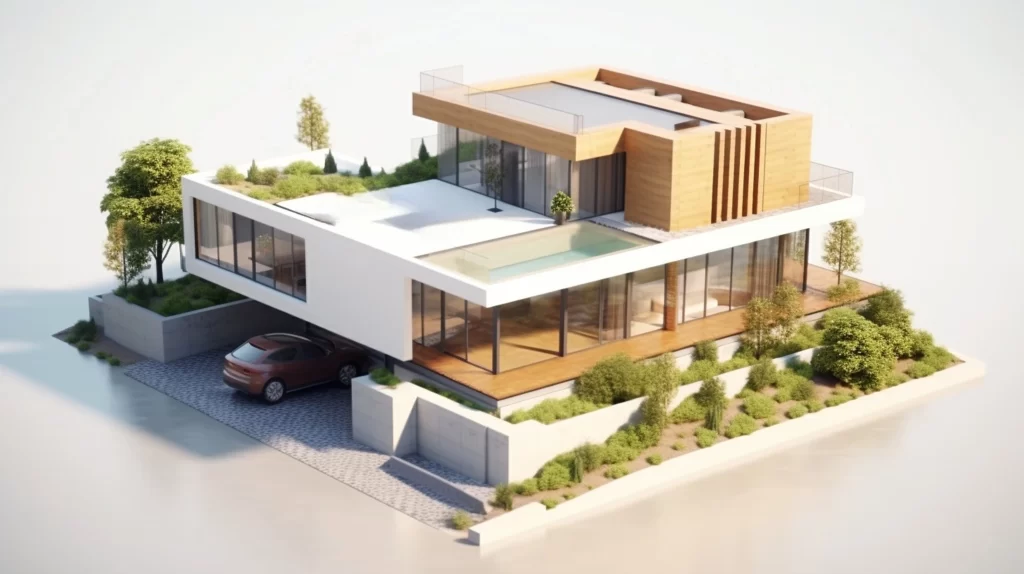
This blog explains how 3D rendering transforms modern house design by turning architectural concepts into lifelike visuals. It covers what 3D rendering is, why it’s essential, the types of renderings, and the complete workflow from modeling to final output. The article also highlights its benefits for real estate, design accuracy, and client communication. Readers also get insights on future trends and tips for selecting the right 3D rendering partner.
Close your eyes and imagine. But why? When your client can actually open their eyes and experience every detail of their house in 3D. Conventional drawings and 2D floor designs are usually not sufficient to convey the actual appearance and feel of a house. Here, the 3D rendering of a modern house has transformed the game for home owners, designers and architects clearly explaining what 3D rendering is and why 3D rendering is essential in modern architectural visualization.
The visual experience via 3D representation of a modern house is a technology-driven experience that takes designs of architectural buildings into the real world in the form of realistic images and walkthroughs. It enables architects, homeowners, developers, and designers to witness their future house in greater detail even before the construction begins. Highly detailed, precise materialising, natural lighting and spatial background, 3D rendering fills the gap between the vision and actual implementation of a design.
Considering the same, we go deeper into what 3D rendering of a house is, why it’s necessary, and how you can realize high-quality contemporary house renderings.
What Is 3D Rendering in Modern House Design?
3D rendering of a modern house refers to the procedure of transforming computer 3D networks on buildings into a realistic image or a series of images. It presents the architectural, interior design, building material, lighting, landscaping and the environment surrounding the building in a rich visual presentation including advanced methods such as aerial 3D rendering for site and exterior visualization.
Although conventional architectural drawings are based on interpretation, 3D rendering is clearer. It displays the precise way a building will appear after it is built. Exterior facades and interior furniture location can be perfectly visualized, which will offer a far more realistic idea of space, size, and beauty.
In contrast to plain drawings, 3Ds show depth, perspective, shadow, light reflections, and texture (a piece of wood, stone, metal, glass, fabric, and tiles). This assists clients to have a clear picture of their homes and make definite choices regarding design and architecture.
Why Is 3D Rendering Important in Designing Modern Houses?
3D rendering of a house can be of great help in design as well as communication and explains why 3D rendering is essential for improving decision-making and execution. It enhances the cooperation of architects, homeowners and construction teams and is associated with numerous advantages.
Key Benefits:
- Helps visualize exterior and interior designs accurately
- Allows quick changes to materials, colors, lighting, and layout
- Reduces design-related misunderstandings and errors during construction
- Saves time and cost by preventing rework and design conflicts
- Helps real estate developers market properties before construction
- Useful for planning, approvals, and client presentations
Because building a new home is such a crucial part of anyone’s life, the 3D rendering of a modern house assists in removing any sort of guess work. It transforms the concept of design into tangible and actual visual properties, which is certain about clarity and trust.
Major Types of 3D Renderings Used for Modern Houses
Various forms of renderings are intended to fulfill different aspects of 3D rendering of a modern house, often delivered by professional 3d rendering service teams. The most popular ones that are used in residential buildings include:
1. Exterior Rendering
Exterior rendering covers the exterior architecture of the house. It depicts the outside of the building, the roof configuration, the exterior lighting, garden, the driveway, and the surroundings of the building, and the effect of the weather. It is normally utilized to represent the curb appeal and the overall style of the house.
2. Interior Rendering
Interior rendering shows the inner space like a living room, bedrooms, kitchens and bathrooms. It records the arrangement of furniture, details such as decorations, wall decorations, flooring, lighting systems, textures and color scheme. Interior rendering assists in the determination of harmony between space functionality and beauty.
3. 3D Floor Plans
A 3D floor plan is a top view of the house illustrating the layouts of space, the relationship between rooms and the movement within the rooms and the simplest furnishings. It provides a clear concept of interaction of living spaces.
4. Virtual Tours and Walkthroughs
A virtual tour enables the users to have a chance to view the house room by room in an interactive manner. It is a simulation of a visit in real-life with 360-degree views with which one can see the house in all directions.
Step-by-Step Process of Creating 3D Rendering for a Modern House
Producing a professional 3D rendering of a house involves a series of carefully planned steps.
Step 1: Collection of Design Inputs
The first thing is to gather architectural drawings, floor plans, elevations, site photographs, sample materials and preferences of the design styles. This assists in the construction of the layout and visual theme.
Step 2: 3D Modeling
A structural 3D house model is prepared using such software as AutoCAD, Revit, or SketchUp. In this model all the components such as doors, windows, walls, roof constructions, room sizes and space orientation are captured.
Step 3: Materials and Textures
The bare 3D model is then improved with the use of realistic material such as wood, glass, marble, tiles, metals, fabric, carpet, and concrete. These textures render the design to be visual and detailed.
Step 4: Lighting Setup
One of the most important elements of rendering is lighting simulation. The shadows and the reflection are included with the help of natural daylight, light direction of the sunlight and artificial light to make everything look more realistic and night-time effects.
Step 5: Rendering Output
Engines such as Lumion, V-Ray, Corona, or Enscape are used in the rendering process to produce high-quality still images or video animations from the 3D model. This level is characterized by a high level of computer processing.
Step 6: Final Improvements and Post-Processing
The final touches are being applied to enhance the image’s quality by improving brightness, contrast, sky, backgrounds, landscape, and realistic finishing touches.
Must-Have Features in Modern House 3D Renderings
To make modern house renderings more appealing and lifelike, certain elements should be incorporated:
Minimalist Architecture
Contemporary homes are based on minimalism, linear lines, and depersonalization of areas. Acute edges, rounded finishes, and geometric forms are believed to be desirable.
Open Layouts
Living room, dining and kitchen areas are also merged to form open floor plans, and this makes them more visible and efficient to use space.
Glass and Natural Lighting
The use of large-sized glass windows, skylights, and glass doors that slide open enable the greatest amount of light to enter into the room, thus making it light and airy.
Natural Materials
Wood, stone, natural fibers and textured heritage walls are the materials that give depth and warmth to visual designs.
Neutral Color Schemes
The interior design of the modern world is usually characterized by light colors like beige, grey, off-white, and earth colors and with wooden textures.
3D Rendering vs Traditional 2D Designs
| Feature | 2D Drawings | 3D Rendering |
| Visualization | Based on imagination | Realistic and detailed |
| Design Accuracy | Limited | High accuracy |
| Customization | Time-consuming | Highly flexible |
| Client Understanding | Moderate | Very high |
| Real Estate Marketing | Low impact | High impact |
3D rendering offers a better design vision and minimizes construction conflicts and enables the clients and stakeholders to comprehend the design and approve the design.
How 3D Rendering Boosts Real Estate Marketing?
Property developers and real estate marketers are more and more adopting the 3D rendering in order to preview projects even before construction starts. Renders assist in selling off-plan properties, attracting investors, and creating the interest of the possible house owners.
Websites, brochures, videos, property portals, and social media campaigns can have high-resolution renderings and walkthrough videos. This enables buyers to be emotionally attached to the property even at a time when a building is still at the planning stage.
Cost Factors Involved in 3D Rendering of a Modern House
The cost of 3D rendering varies depending on:
- Size of the property and design complexity
- Whether you need interior, exterior, or both
- Quality level (basic, realistic, photorealistic)
- Number of views and image resolutions
- Whether you need animation or still images
- Revision cycles and deadline urgency
Simple renderings are affordable and more intricate photorealistic walkthroughs and animations are more intensive, time-consuming, and expensive.
Future of 3D Rendering in Architecture
Technological developments are shaping the future of architectural visualization. Some emerging trends include:
The future of architectural visualization is taking a technological trend. There are emerging tendencies that are:
Artificial Intelligence-Based Rendering
AI-based rendering can cut the design time and automatize the process of material selection, scenery creation, and optimization of lights.
Gaming Engine Real Time rendering
Programs such as Unreal engine and Unity allow real time walkthroughs where modifications in a design automatically update in the visual output.
Home Visualization in VR and AR
Virtual Reality enables the homeowners to explore their future house in VR headsets whereas Augmented Reality integrates 3D house models in the real world through mobile gadgets.
Digital Showrooms and Metaverse
Online rooms and metaverse allows showing complete designs of houses with all features of interactivity, so customers can adjust the layouts in real time.
How to Choose the Right 3D Rendering Partner?
Selecting the right rendering specialist or studio is important for achieving quality output.
A few quick factors to consider:
- Quality and realism in portfolio samples
- Understanding of architectural detailing
- Ability to translate ideas into accurate visual output
- Experience with relevant software and tools
- Capacity for timely revisions and client collaboration
Final Thoughts
3D representation of a contemporary house is a revolutionary tool that has given visualization, accuracy and clarity of design. It eases the interaction between architect, designer and clients. It also assists in making informed choices, avoiding the mistakes in design, and improving the overall process of architectural planning when supported by the right 3D rendering consultant.
At personal home design, residential project design, or at promoting houses on the market, 3D rendering is an intelligent, efficient, and visually strong solution to visualizing architecture.