
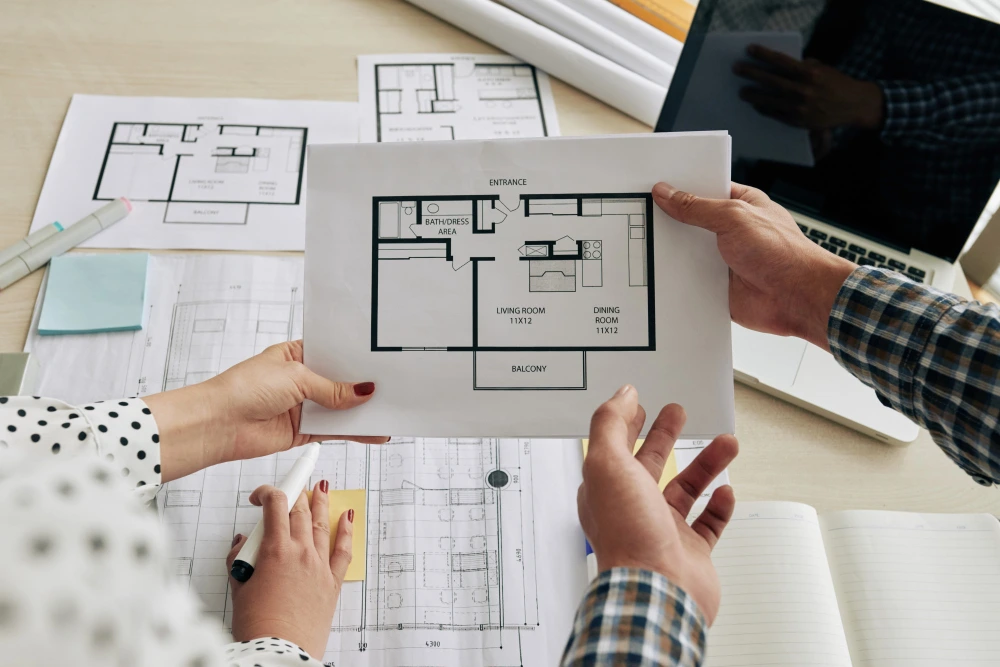
The debate between open floor plan vs segmented spaces is one of architecture’s most enduring design decisions and 3D Rendering Services have completely changed how designers, builders, and homeowners approach it. This blog explores both layout philosophies, why 3D Floor Plans are Better Than 2D CAD Pics for communicating spatial concepts, and how 3D Architectural Visualization Services give every stakeholder a clear, photorealistic view of either option before a single wall is built.
Every home design journey arrives at the same crossroads: should the space breathe freely with an open floor plan, or should it be structured with defined rooms and purposeful boundaries through segmented spaces? It’s a decision that shapes how a family lives, how a business operates, and how a property performs in the market.
What’s changed dramatically in recent years is not the debate itself it’s the tools available to visualize and resolve it. 3D Rendering Services have transformed this once-abstract conversation into a concrete, visual experience. Instead of asking clients to imagine a space from a blueprint, architects and designers can now present photorealistic, walkable environments of both layouts side by side, in full detail before construction begins.
This blog examines both floor plan philosophies, the unique strengths each brings to different contexts, and why Architectural Floor Plan Renderings produced through professional 3D Architectural Visualization Services are the most powerful decision-making tool available to designers and homeowners today.
Understanding Open Floor Plans
An open floor plan removes interior walls between common living areas typically merging the kitchen, dining room, and living room into one large, continuous space. The concept became popular in the mid-20th century, driven by a cultural shift toward casual, connected family living and supported by advances in structural engineering that made large open spans achievable without compromising stability.
The defining characteristics of an open floor plan include:
Natural Light Flow: Without walls to interrupt sightlines, daylight travels freely across the entire shared space. Rooms feel brighter, more energetic, and considerably larger than their actual square footage.
Social Connectivity: Whether hosting guests, supervising children from the kitchen, or maintaining conversation across the cooking and living zones, the open plan removes the physical barriers that previously isolated family members during everyday routines.
Spatial Flexibility: Furniture defines zones rather than walls. This allows homeowners to reconfigure the layout over time without structural renovation a significant advantage as lifestyle needs evolve.
Perceived Square Footage: Open plans create the visual impression of a larger, more expansive home. This is one of the primary reasons open-concept designs consistently command stronger resale values in the real estate market.
The drawbacks are equally real: noise travels without impediment, smells from cooking spread throughout the space, privacy is reduced, and energy costs for heating and cooling a large undivided area can be higher than controlling individual rooms independently.
Understanding Segmented Spaces
Segmented spaces also called traditional or closed floor plans use interior walls, doors, and dedicated corridors to define individual rooms, each with a clear and contained purpose. A separate kitchen, a formal dining room, a closed living room, and a distinct home office represent the segmented approach at its most structured.
The resurgence of interest in segmented layouts in 2025 and 2026 has been driven by several lifestyle factors: the widespread adoption of remote work requiring dedicated, acoustically separated home offices; multi-generational households needing true privacy zones; and a broader cultural appreciation for cozy, intimate spaces after years of open-concept dominance.
Key advantages of segmented spaces include:
Acoustic Privacy: Walls contain sound. A focused work call, a child’s study session, or a quiet bedroom retreat remains genuinely isolated from the activity in other parts of the home.
Energy Efficiency: Individual rooms can be temperature-controlled independently. Heating or cooling only the spaces in active use is measurably more efficient than conditioning one vast open area.
Defined Purpose: When every room has a clear function dining room for meals, study for work, sitting room for relaxation there’s a psychological clarity to the layout that many homeowners find grounding and purposeful.
Clutter Containment: Mess is hidden behind closed doors. An untidy kitchen doesn’t affect how the living room looks, and vice versa.
The limitations of segmented layouts include reduced natural light (walls block it), a potential feeling of cramped separation in smaller homes, and less flexibility for large-scale entertaining.
Why 3D Floor Plans are Better Than 2D CAD Pics for This Decision
This is where the conversation about floor plan preference becomes a conversation about visualization technology and it’s a significant one.
Traditional architectural drawings the flat, overhead 2D CAD layouts that show room dimensions and wall placements are useful for construction documentation but are largely inaccessible to most clients. Reading a 2D plan requires spatial imagination that most homeowners simply don’t have. They can see that a room is 14 by 18 feet on paper, but they cannot feel whether that space is generous or cramped, light or dark, connected or isolated.
3D Floor Plans are Better Than 2D CAD Pics in every way that matters for client decision-making:
A 3D Rendering of a Modern House floor plan shows furniture at scale, accurately placed within the space. A client can immediately see whether a dining table fits comfortably between the kitchen island and the living area in an open plan, or whether the segmented dining room has enough circulation space around the table.
Light is simulated in photorealistic 3D renderings showing how morning sun enters from the east-facing windows, how shadows fall across an open kitchen, and how a north-facing segmented room might feel cooler and darker. These are invisible in a 2D plan.
Material selections flooring transitions, wall finishes, ceiling heights come to life in 3D, making the conceptual difference between a warm segmented interior and a bright open-plan living area tangible and immediately comparable.
How 3D Rendering Services Visualize Both Options
Professional 3D Rendering Services approach the open vs. segmented debate by producing detailed, photorealistic representations of both layouts for the same property giving clients a genuine comparison rather than an abstract choice.
The Process of 3D Rendering for floor plan visualization typically follows these stages:
Consultation and Brief: The rendering studio receives the base architectural drawings or concept sketches and discusses the client’s lifestyle priorities entertaining, privacy, family size, work-from-home requirements to understand which layout attributes matter most.
3D Modeling: Both layout options are modelled in three dimensions with accurate wall placements, ceiling heights, door and window positions, and furniture arrangements. This is where the spatial reality of each option is first established in the digital environment.
Lighting and Materials: Realistic lighting is applied to both models natural daylight, artificial interior lighting, and the interaction between them. Material finishes are applied to surfaces. This is the stage where the emotional character of each layout becomes visible.
Rendering and Output: High-resolution photorealistic images are generated. For particularly complex projects, Aerial 3D Rendering can be produced a birds-eye perspective of the floor plan that shows the overall spatial organization of both layouts simultaneously and is especially effective for client presentations.
Review and Refinement: Clients review the rendered options and request adjustments perhaps a half-wall between kitchen and living in the open plan, or a wider doorway in the segmented layout to improve flow. Revisions are incorporated before final delivery.
3D Rendering of a House Is Essential for Designers and Homeowners
There is a reason why the statement that 3D Rendering of a House Is Essential for Designers and Homeowners has moved from aspiration to industry standard: it fundamentally improves decision quality.
When a homeowner can see a photorealistic rendering of their specific property with an open floor plan furniture at scale, natural light flooding through the kitchen window, sight lines from the living area to the backyard and compare it directly against a rendering of the same property with segmented spaces a dedicated study with acoustic separation, a formal dining room with warm contained lighting they make better decisions. Faster, with more confidence, and with fewer costly revisions during construction.
For designers, the ability to present both options visually removes the guesswork from client briefings. Instead of explaining why an open plan might feel more spacious for a particular family’s lifestyle, they can show it. Instead of describing how a segmented layout could create the dedicated home office a remote worker needs, they can demonstrate it with a fully rendered interior that feels genuinely real.
Realistic Outdoor Visualizations: Completing the Picture
The floor plan debate doesn’t exist in isolation. Realistic Outdoor Visualizations complement interior floor plan renderings by showing how the chosen layout connects to exterior spaces terraces, gardens, pool areas, and entry approaches.
An open-plan interior that connects via large sliding doors to a landscaped terrace tells a very different story when that outdoor connection is visualized in photorealistic detail. A segmented layout with a private study opening onto a quiet courtyard presents its own compelling lifestyle narrative. Pairing interior Architectural Floor Plan Renderings with Realistic Outdoor Visualizations gives clients the full picture not just of the floor plan, but of how the home lives from inside to outside.
3D Rendering for Marketing: Selling the Vision
Beyond design decision-making, 3D Rendering for Marketing is one of the most commercially significant applications of architectural visualization for floor plan content.
Real estate developers and agents who market properties before construction or before renovation rely on high-quality 3D Architectural Visualization Services to communicate spatial layout to buyers who cannot yet physically visit the space. A compelling 3D Rendering of a Modern House showing the open-plan living, kitchen, and dining area as a unified, light-filled space sells the lifestyle of that floor plan far more effectively than any verbal description or 2D drawing could.
This applies equally to segmented layouts marketed toward buyers who prioritize privacy and dedicated functionality families with multiple children, professionals working from home, or multi-generational households seeking independent living zones.
The Future of 3D Rendering and Floor Plan Visualization
The Future of 3D Rendering in floor plan visualization is moving rapidly toward interactivity. Emerging 3D Rendering Trends include real-time walkthroughs that allow clients to move through both open and segmented versions of their proposed home in real time, adjusting materials, furniture, and lighting on the fly. AR and VR integrations are making it possible to experience rendered floor plans at full human scale, standing inside the virtual space to feel ceiling heights and room proportions in a way that no static image can replicate.
Artificial intelligence is beginning to assist the Process of 3D Rendering itself automating material application, suggesting furniture layouts based on room dimensions, and generating variation renders faster than ever before. What took days is increasingly achieved in hours, making high-quality 3D Rendering Floor Plans more accessible to a wider range of projects and budgets.
Conclusion
The choice between an open floor plan vs segmented spaces is ultimately personal shaped by lifestyle, family dynamics, acoustic needs, energy priorities, and aesthetic preferences. Neither is universally superior. Both can be exceptional when designed with intention and communicated clearly.
What 3D Rendering Services provide is the clarity that makes that choice genuinely informed rather than speculative. Through photorealistic Architectural Floor Plan Renderings, both options become visible, comparable, and emotionally resonant transforming one of architecture’s most consequential decisions from an abstract debate into a clear, confident choice.
At Arktek 3D, we specialize in bringing exactly this kind of clarity to every project from 3D Architectural Visualization Services for residential homes to Aerial 3D Rendering for complex developments, always with the precision and realism that helps designers, homeowners, and developers move forward with confidence.