
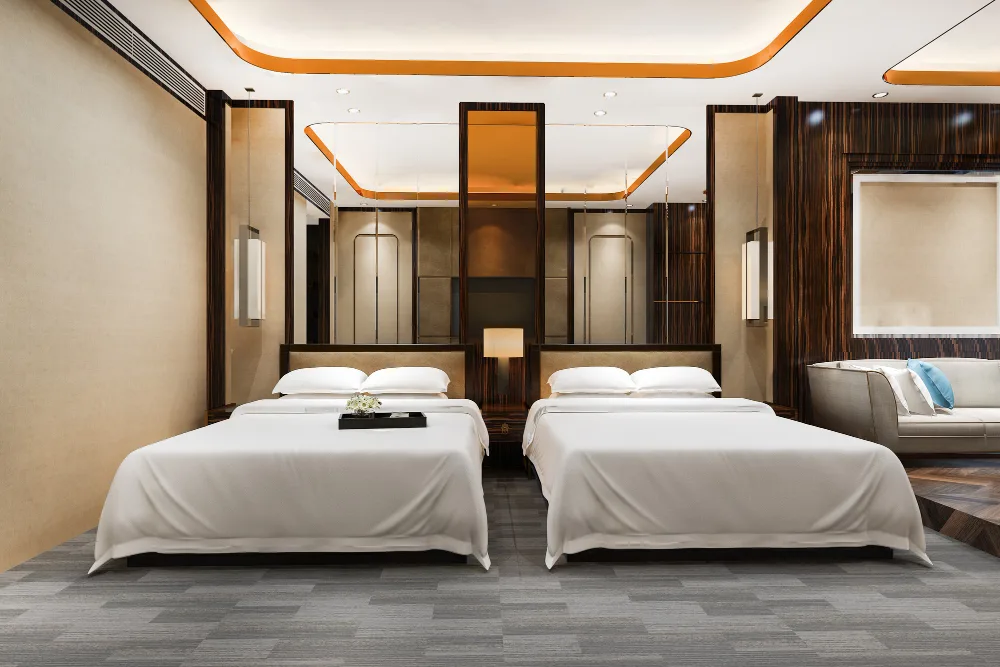
Hospitality brands are built on experience and atmosphere, and 3D interior rendering is what lets designers test and communicate that vision before construction begins. This guide covers how hotel and resort interior rendering strengthens brand consistency, supports marketing, and helps stakeholders approve designs faster.
Long before a guest ever walks into a lobby, a hotel or resort brand has already made its first impression through the images used to sell the vision. Getting that vision right, and getting stakeholders to agree on it early, is exactly where 3D interior rendering earns its place in hospitality design. It’s the bridge between an abstract brand concept and a space guests can actually picture themselves standing in.
What Hotel Interior Rendering Actually Involves
Hotel interior rendering combines accurate 3D modeling, furniture and fixture placement, material and lighting simulation, and photorealistic post-production into a single, believable image of a finished space. Compared to a mood board or a flat CAD drawing, a proper 3D interior rendering service gives every stakeholder designers, investors, and marketing teams alike a far more accurate sense of how a space will actually look and feel once built.
Resort interior rendering carries the same technical process but usually leans harder into atmosphere: open, sun-filled spaces, natural textures, and a sense of escape that reflects the leisure experience a resort is selling, as opposed to the more polished, controlled mood typical of an urban business hotel.
Why This Matters So Much for Hospitality Brands
Hospitality spaces aren’t just functional buildings they’re experience-driven, brand-defining destinations. Every material choice, lighting decision, and spatial layout communicates something about the brand before a single guest ever checks in. This is exactly why hotel interior design visualization has become essential rather than optional for serious hospitality projects.
Rendering in interior design, at its core, means translating design intent into something stakeholders can actually evaluate not just spatial layout, but ambiance, luxury positioning, and the emotional tone a brand wants guests to feel the moment they walk in. Understanding what rendering mean in interior design in a hospitality context is different from residential work: a beachside resort might lean into warm natural textures and open sightlines to signal relaxation, while a premium urban hotel uses polished materials and controlled lighting to project exclusivity.
How 3D Rendering Reinforces Brand Consistency
One of the biggest challenges for a hospitality brand with multiple guest rooms, suites, and public areas is maintaining a consistent design language across all of them. 3D Rendering in Interior Design workflows let design teams test furniture layouts, material combinations, and lighting schemes across every space before construction begins, catching inconsistencies early rather than discovering them after a room is already built.
This same process also helps identify practical issues clearance problems, awkward guest circulation, or mismatched proportions well before they become expensive on-site corrections. In that sense, rendering functions less like a marketing tool and more like a strategic design-validation step that happens to also produce beautiful imagery along the way.
The Elements That Make Hospitality Renders Feel Real
A handful of details separate a render that genuinely sells a hospitality brand from one that looks flat and generic:
Lighting is arguably the most powerful tool available. Simulating natural daylight, warm evening ambience, and layered artificial lighting shapes mood far more than any single material choice soft lighting suggests relaxation, while dramatic lighting reinforces luxury and exclusivity.
Material realism matters just as much. Hospitality interiors lean heavily on marble, brass, wood, glass, and fabric, and each behaves differently under light. Getting reflectivity, texture, and roughness right is what makes a render feel tangible instead of artificial.
Composition and spatial storytelling guide how a viewer experiences a space a well-framed render doesn’t just show a room, it highlights flow, hierarchy, and the emotional focal point the design was built around.
Transforming Interiors Before They’re Built
This is where the real value of the process shows up: teams can Transform Interiors with 3D Rendering long before construction starts, testing multiple furniture arrangements, finish combinations, or even entirely different design directions without touching a single physical material. That flexibility saves both time and budget, and it means the version that finally gets built has already been stress-tested visually.
Beyond Hospitality: A Skill That Transfers
The same technical discipline used for hotel and resort projects applies directly to Interior 3D Rendering for Luxury Residential Projects, where material accuracy and lighting mood matter just as much for selling a high-end home as they do for a resort suite. A studio comfortable working across both categories tends to bring a sharper eye for detail to hospitality work specifically, since luxury residential clients are often just as particular about finish accuracy.
Why Interior Designers Rely on Rendering for Marketing
Why Interior Designers Use 3D Rendering for Marketing comes down to reusability and reach. A single, well-produced set of renders can support investor presentations, pre-launch marketing campaigns, social media content, and printed brochures all from one production effort, without the cost of physical staging or waiting for construction to finish before marketing can begin.
The Practical Benefits, Summarized
The Benefits of 3D Interior Rendering Services for hospitality projects go well beyond attractive imagery:
- Clearer communication between architects, designers, and investors, since photorealistic visuals are far easier to interpret than technical drawings
- Earlier identification of design flaws, reducing costly late-stage changes
- Faster stakeholder approvals, since decision-makers can evaluate a realistic representation rather than an abstract concept
- Reusable marketing assets across multiple channels from a single rendering investment
- Stronger, more consistent brand identity across every guest-facing space in a property
The Role of Lighting, Revisited
It’s worth returning to lighting one more time, because the Role of Lighting in Photorealistic Interior Renders is often underestimated by teams new to this process. Lighting doesn’t just illuminate a space in a render it defines depth, mood, and material perception all at once. A poorly lit render can make even excellent architecture and materials look flat, while a well-lit one can make a modest space feel genuinely aspirational.
Final Thoughts
For hotels and resorts, interior rendering has moved well past being a nice-looking visual add-on it’s become a core part of how brand identity gets designed, tested, and communicated before a space physically exists. From early design validation to final marketing assets, 3D interior rendering gives hospitality brands the clarity and consistency they need to get the guest experience right from the very first image.
If you’re planning a hospitality project and want renders built around your brand’s specific identity, reach out to the Arktek 3D team for a consultation.
Frequently Asked Questions
How is hotel interior rendering different from standard residential rendering?
Hospitality rendering has to communicate brand identity and emotional atmosphere, not just spatial layout meaning lighting, material selection, and composition are held to a higher standard than most residential projects, where accuracy alone is often enough.
Can the same renders be used for both design approval and marketing?
Yes this is one of the biggest practical advantages of a strong 3D interior rendering service. A single set of accurate renders can support internal design sign-off, investor presentations, and external marketing campaigns without additional production work.
What’s the biggest mistake hospitality brands make with interior rendering?
Treating it purely as a marketing afterthought rather than a design tool. Renders produced late in the process miss the chance to catch layout or material issues early, which is where much of the real value of 3D Rendering in Interior Design actually lies.
Related reading
For a deeper look, see our guide to brand-standard hotel rendering: Guide to brand-standard hotel rendering.